 EN
EN

When gym managers and fitness facility designers think about flexible floor planning, dumbbells consistently emerge as one of the most valuable assets in the space. Unlike large fixed machines that demand permanent floor footprints and specialized electrical or structural support, dumbbells offer a level of spatial freedom that few other pieces of equipment can match. Understanding why dumbbells hold this position is critical for any facility looking to maximize both performance and adaptability.
Flexible gym floor planning is not just a design preference — it is a competitive necessity. Members expect varied training environments, and operators need layouts that can shift as programming changes. Dumbbells support this demand better than almost any other category of training equipment, and the way they are organized and stored plays a direct role in how successfully a facility can reconfigure its floor at any time.
The Spatial Versatility Dumbbells Bring to Any Layout
Compact Footprint with Maximum Training Range
Dumbbells occupy remarkably little fixed floor space relative to the breadth of exercises they support. A full set of dumbbells, when properly stored on a rack, can be positioned against a wall, in a corner, or along a mirrored zone without interrupting the central training area. This makes dumbbells one of the few equipment categories that can serve both as primary training tools and as peripheral elements that do not dominate the floor plan.
When a gym needs to expand its group training zone for a peak-hour class or open up space for functional movement circuits, dumbbells can remain in place without conflict. Their storage footprint is predictable and contained, which gives floor planners reliable spatial constants to design around. Other large machines may need to be relocated or removed entirely when the layout needs to shift, but dumbbells stay put and still serve their purpose.
Compatibility with Multiple Training Zones
Dumbbells integrate naturally into strength zones, functional training areas, recovery corners, and personal training bays. Because dumbbells do not require power sources, cable anchoring, or fixed hardware, they can transition between zone types as the gym's programming evolves. A personal training bay can absorb a set of dumbbells just as readily as a dedicated free weights floor can. This cross-zone compatibility makes dumbbells a planning asset rather than a planning constraint.
How Dumbbells Support Dynamic Programming Needs
Serving Diverse Member Populations Simultaneously
A well-stocked dumbbell selection serves beginners, intermediate lifters, and advanced athletes at the same time. Dumbbells ranging from light to heavy allow multiple members to train simultaneously in the same zone without requiring separate equipment categories for each fitness level. This density of utility means that one properly organized dumbbell station can support a far broader range of workouts than a comparable footprint of single-purpose machines.
Gym floor planners benefit from this because dumbbells reduce the need to allocate separate floor zones for different training populations. Instead of designating one section exclusively for beginners and another for advanced members, a thoughtfully arranged dumbbell area serves the entire membership at once. This consolidation creates breathing room elsewhere on the floor for specialty equipment or open movement zones.
Adaptability When Programming Changes
Fitness programming trends shift regularly, and gym operators who invest heavily in fixed machines can find their layouts quickly becoming outdated. Dumbbells do not carry this risk. As new training methodologies gain popularity — whether circuit-style conditioning, strength endurance protocols, or hybrid functional formats — dumbbells remain relevant and useful. Their role in the layout does not need to change even when the programming around them does.
This durability of relevance means that dumbbells are a long-term planning investment. A gym that builds its floor plan around a strong dumbbell foundation gives itself the flexibility to adopt new programming directions without major renovation. The floor can evolve, but the dumbbell zone remains a reliable anchor point throughout that evolution.
Storage Solutions That Maximize Dumbbell Floor Efficiency
Rack Design as a Floor Planning Tool
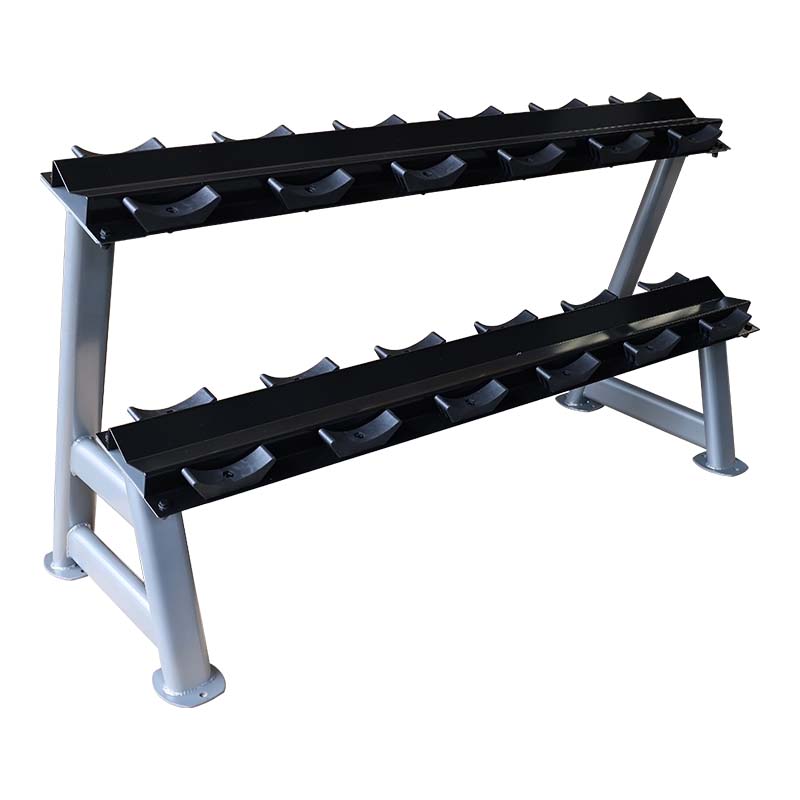
The way dumbbells are stored directly affects how much floor space they consume and how easily the surrounding area can be reconfigured. Vertical and horizontal dumbbell racks are designed to minimize floor contact while keeping all weights accessible and organized. A well-chosen rack keeps dumbbells off the floor, eliminates trip hazards, and defines the boundary of the dumbbell zone cleanly so that adjacent areas remain open and usable.
Commercial-grade dumbbell racks built specifically for gym environments offer tiered storage that fits a full weight range in a compact linear arrangement. This means that even a gym with a comprehensive dumbbell selection spanning from light to very heavy does not need to sacrifice large sections of the floor to accommodate them. The right rack design turns what could be a sprawling collection into a tightly managed, space-efficient station.
Positioning Dumbbells for Flow and Safety
Where dumbbells are placed on the floor plan matters as much as how they are stored. Positioning dumbbells along walls or at the perimeter of the training floor keeps the center open for dynamic movement. Members can retrieve dumbbells, move to their preferred training spot, and return them without crossing through active exercise areas. This flow logic reduces congestion and supports a safer, more comfortable training environment.
Gym operators who treat dumbbell placement as a flow management decision — rather than simply finding wherever they fit — discover that dumbbells actually improve the overall efficiency of the space. A floor plan built around thoughtful dumbbell positioning feels more open, less cluttered, and easier to navigate even when the gym is at peak capacity.
FAQ
How many dumbbells does a commercial gym typically need?
Most commercial gyms benefit from a full range of dumbbells covering light through heavy weights, often in increments of 2.5 to 5 kilograms. The specific quantity depends on member volume, but having multiple pairs at popular weight ranges ensures that dumbbells remain available during busy periods without causing wait times or floor congestion.
What type of flooring works best in a dumbbell zone?
High-density rubber flooring is the standard choice for dumbbell areas because it absorbs impact, protects the subfloor, and provides a stable surface for both storage racks and active training. Rubber tiles or rolled rubber in 8 to 15 millimeter thickness are common specifications for zones where dumbbells are regularly used and replaced on racks.
Can dumbbells be incorporated into group fitness layouts?
Yes, dumbbells are highly compatible with group fitness formats. Portable dumbbell storage solutions allow weights to be redistributed across the training floor before a class and returned to a central rack afterward. This flexibility makes dumbbells one of the most practical tools for gyms that host both open floor training and structured group sessions in the same space.